

BETA DEAL
LUXOR'S LEGACY
FROM DUST TO ETERNITY
LDS PERSPECTIVE ON:
CREATION → CORONATION → EXALTATION
LAND PACKAGES START AT $1897pp
CONTACT FORM


ITINERARY

Day 1 (Sat) USA → Cairo
Depart the USA overnight flight
Day 2 (Sun) Cairo
Arrive in Cairo, stay Le Meridien Airport Hotel (or similar)
Day 3 (Mon) Cairo → Luxor
Fly to Luxor, hotel check-in, evening free
Day 4 (Tue) Luxor
Balloon Ride (optional), Karnak & Luxor Temples
Day 5 (Wed) Luxor
Dendera & Abydos Temples, lunch included
Day 6 (Thu) Luxor → Cairo
Valley of the Kings tour, flight to Cairo
Day 7 (Fri) Cairo
Old Cairo & National Museum of Egyptian Civilization
Day 8 (Sat) Cairo
Grand Egyptian Museum, Pyramids, Sphinx
Day 9 (Sun) Cairo → USA
Return flight (late previous evening or early AM)
YOUR GUIDES
.png)
Haitham
Egyptologist & Guide

Emad
Experience Manager

Brian
LDS Host & Co-Owner
*Subject to availability
DATES & PRICING
AVAILABLE DATES:
Trips run Saturday to the following Sunday
WINTER/SPRING DATES
Starting January 17th
SUMMER DATES (hot)
Starting April 18th
FALL DATES
Starting September 26th
All dates land touring:
$1897 PER PERSON
Based on double occupancy. Subject to availability.
Book with 2+
couples and get
$150 off/ppdo
*Flights not included. See flight information section below for flight booking.
THIS PACKAGE INCLUDES:
EGYPTOLOGIST GUIDE WITH LDS PERSPECTIVES
QUALITY PREFERRED HOTELS
ADMISSIONS TO MUSEUMS & SITES
GROUND TRANSPORTATION
FULL TIME EXPERIENCE MANAGER
NOT INCLUDED:
-
Meals (unless mentioned in itinerary) - ~$30/day
-
Flights - cost varies by date
-
Optional balloon experience - ~$200
-
Tips and Gratuities - ~$17/day x 6 days
-
Insurance - can send quote upon request
-
Personal items and souvenirs
FLIGHT INFORMATION
Flights are not included in the tour price, and must be purchased separately.
Our staff is available to help book flights if desired.
Here is the suggested flight schedule for this trip from SLC. Other US cities available with similar itineraries.
Departure
Saturday: Overnight flight from USA airport of choice to Cairo (CAI)
Sunday: Arrive in Cairo (CAI)
Within Egypt
Monday: Flight from Cairo (CAI) → Luxor (LXR)
Thursday: Evening flight Luxor (LXR) → Cairo (CAI)
Return (8 days later)
Sunday: Early morning departure from Cairo (CAI) to USA airport of choice
Our In House Flight Reservation staff are available to quote and book flights upon request.
EXTENDED ITINERARY
SATURDAY Day 1 - USA Departure
As you leave home and journey to Egypt, reflect on Abraham’s own journey into Egypt (Genesis 12). His faith to follow God’s direction reminds us that travel can be both spiritual, and physical. The Doctrine and Covenants encourages us to learn about the earth and explore the world in Doctrine and Covenants 88:79, which commands the Saints to be instructed in “things both in heaven and in the earth, and under the earth; things which have been, things which are, things which must shortly come to pass… things of the earth, and the inhabitants thereof.” This verse is often cited as a divine mandate to study creation, history, cultures, and the natural world.
SUNDAY Day 2 - Arrival in Cairo
You'll arrive in Cairo on Sunday and check in to Le Meridien Airport Hotel (or similar). You'll probably be exhausted and jet lagged from the travel, you're welcome to explore the city if you have the energy, or start adjusting your sleep schedule.
MONDAY Day 3 - Flight to Luxor
On Monday you'll take a quick flight from Cairo to Luxor. The time of this flight will depend on availability when you book, we recommend a mid morning flight if possible. Then you'll check into the Luxor hotel that you'll be staying at during your time in Luxor, breakfast will be included. The experience manager Emad will give you some great recommendations for food at all different budget and adventure levels.
TUESDAY Day 4 - Balloon Ride*, Karnak & Luxor Temples
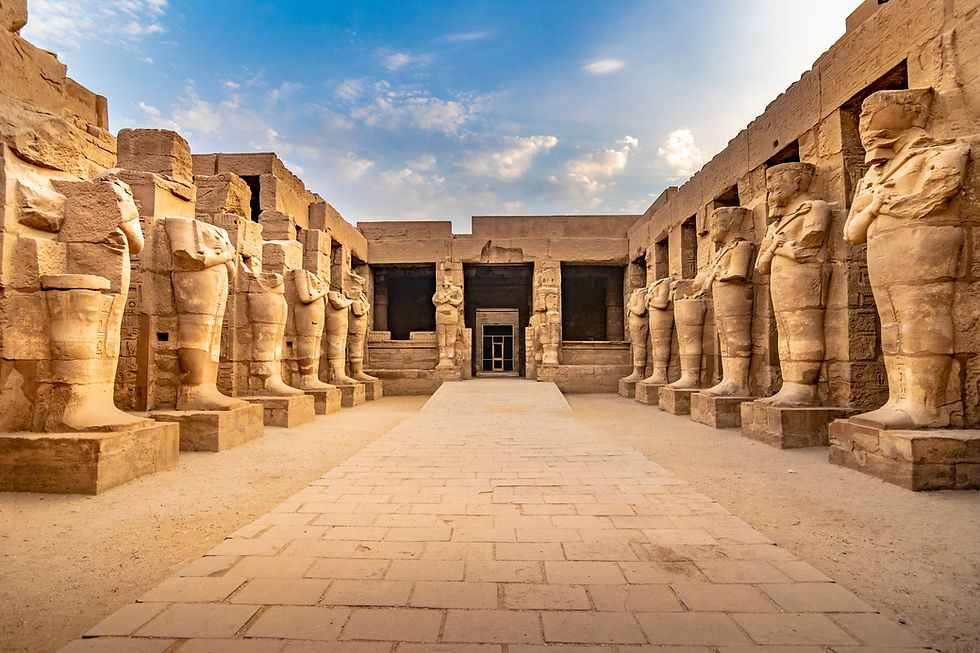
The Temple of Luxor, linked to Karnak by the grand Sphinx Avenue, was a central site of worship for Amun‑Ra, his consort Mut, and their son Khonsu. Each year during the Opet Festival, sacred statues were carried in procession from Karnak to Luxor, symbolizing divine union and fertility. Built primarily by Amenhotep III and completed by Ramses II, the temple reflects contributions from several pharaohs, including Tutankhamun. Over centuries, it became a place where three faiths overlapped — ancient Egyptian religion, early Christianity, and Islam, with a mosque still active today. Visitors will see colossal statues of Ramses II, remnants of Christian chapels, and the mosque rising above the ancient courtyard, making Luxor Temple a living testimony to Egypt’s layered spiritual history.
At the Temple of Opet, located at the Karnak Temple, we encounter carvings that echo Facsimile 1 from the Book of Abraham. Critics have claimed Joseph Smith erred in depicting Abraham with legs apart and hands raised, but here in Egypt we see that very posture — the hieroglyphic symbol of supplication and prayer. This imagery not only validates the facsimile but also points to deeper truths: Abraham praying to God, Osiris symbolizing resurrection, and Christ fulfilling that promise for all mankind. These sacred parallels remind us that ancient Egypt’s yearning for eternal life connects directly to the Abrahamic Covenant and the doctrine of resurrection.
*Balloon Ride is an optional add on.
WEDNESDAY Day 5 - Temples of Dendera & Abydos
The Temple of Dendera is one of the most complete and well‑preserved temples in all of Egypt. Its chambers, sanctuaries, and side chapels still carry vivid carvings and inscriptions that allow us to step directly into the religious world of the ancients. Within one of these rooms, visitors encounter imagery that directly parallels Facsimile 1 from the Book of Abraham.
In Dendera and Abydos, carvings show figures with legs apart and hands raised in supplication — validating Facsimile 1 as Abraham praying to God, a posture critics once denied existed. Nearby inscriptions echo the cosmological themes of Facsimile 2, the hypocephalus, which represents the order of creation, divine light, and eternal truths. And in adjoining chapels, depictions parallel Facsimile 3, showing a figure being introduced into the presence of deity — a powerful symbol of exaltation and entrance into the divine council.
Together, these three facsimiles testify of the Abrahamic Covenant: prayer and supplication (Facsimile 1), creation and eternal order (Facsimile 2), and exaltation in God’s presence (Facsimile 3). Ancient Egyptians sought resurrection through Osiris, but we see in these symbols a foreshadowing of Christ’s resurrection and the promise that all may rise and enter God’s presence through covenant.
THURSDAY Day 6 – Valley of the Kings & Flight to Cairo
Explore the Valley of the Kings.
Tombs of pharaohs reveal their fascination with resurrection and eternal life.
The elaborate tombs remind us of Alma’s teachings that “there is a resurrection, a restoration of all things” (Alma 40). Pharaohs prepared for eternity with treasures, but we prepare with covenants. Their longing for immortality parallels our doctrine of eternal families.
Inside the Tomb of Seti, nearly every column is adorned with vivid, original‑color carvings of the ritual embrace — the pharaoh clasping hands or shoulders with a god. In Egyptian symbolism, this embrace was more than a greeting; it represented atonement, acceptance, and the bestowal of divine blessings. The god’s hand often appears raised, signifying that words of blessing are being spoken, conferring stability, authority, health, and eternal posterity upon the king.
For Latter‑day Saints, this imagery resonates deeply with temple worship. The embrace parallels the sacred moment of passing through the veil, where the faithful are received into God’s presence. Just as the pharaoh was endowed with authority, posterity, and eternal inheritance through the embrace, covenant‑keepers today receive promises of priesthood power, eternal families, and joint‑heirship with Christ.
The Egyptians sought permanence in dynasty and resurrection through Osiris; the restored gospel reveals the true fulfillment of those hopes in Jesus Christ. Thus, the ritual embrace at Seti’s tomb becomes a striking witness that ancient civilizations yearned for the same blessings we receive in the temple — authority, posterity, health, and eternal inheritance from the Father.
FRIDAY Day 7 – Old Cairo & National Museum of Egyptian Civilization
Visit Old CairoOld Cairo connects us to early Christianity. Here we recall the flight of Mary, Joseph, and the infant Jesus into Egypt (Matthew 2:13–15). Egypt became a place of refuge, just as temples today are places of refuge for covenant keepers.
Tour the National Museum of Egyptian CivilizationThe museum houses treasures spanning Egypt’s entire history — from ancient dynasties to Christian and Islamic eras. Among its most striking exhibits are the royal mummies, carefully preserved as the Egyptians sought to secure resurrection and eternal life. Their elaborate preparations reflect mankind’s universal yearning for immortality.
The Egyptians looked to Osiris as the god of resurrection; we look to Jesus Christ, who truly conquered death and offers eternal life to all. The museum’s collection of artifacts across different faiths also testifies that throughout history, people have sought God in diverse ways — yet the Abrahamic Covenant and temple ordinances reveal the fullness of how those promises are fulfilled.
SATURDAY Day 8 – Grand Egyptian Museum, Pyramids & Sphinx
See the Pyramids of Giza & the Sphinx
The pyramids symbolize mankind’s quest for eternity. Their enduring stone structure reminds us of Christ as the “chief cornerstone” (Ephesians 2:20). The Sphinx, guarding the pyramids, can symbolize vigilance in keeping covenants and protecting sacred truths.
Visit the NEW Grand Egyptian Museum (GEM)
Located near the Giza Pyramids, the GEM is the largest archaeological museum in the world dedicated to a single civilization. Opened in 2025, it houses more than 100,000 artifacts, including the entire Tutankhamun collection displayed together for the first time. Visitors are greeted by the colossal statue of Ramses II in the Grand Hall, and can explore galleries that span Egypt’s history from the Old Kingdom through the Greco‑Roman period.
SUNDAY Day 7 – Return flights to USA
We recommend finding an early morning flight back to your home airport.
BOOKING INFORMATION
-
Payment is due in full upon booking. All flight*, and hotel reservations are secured at the time of booking.
-
After you complete your booking, we will email you an offer to purchase travel insurance.
-
Cancellation Policy - all cancellations will be subject to vendor Terms & Conditions.
* Flights are priced separately from ground touring, and are an additional cost.